


Five ways to charge 14 trucks in one night
One 1 MW connection, real day-ahead prices and grid tariffs, and batteries that charge more slowly as they fill. Four common strategies leave at least one truck short. One charges them all, for the least.
In short
- Load balancing runs against the full 1,000 kW connection, still leaves one truck short and costs 17% more.
- A flat 100 kW keeps the peak at 825 kW, but a truck that only stays briefly never fills up: 6% more.
- A flat 400 kW plan ignores how charging slows as a battery fills: ten trucks leave short, and the bill rises 36%.
- The same plan with a safety margin is safer but less flexible: one truck short, 12% more.
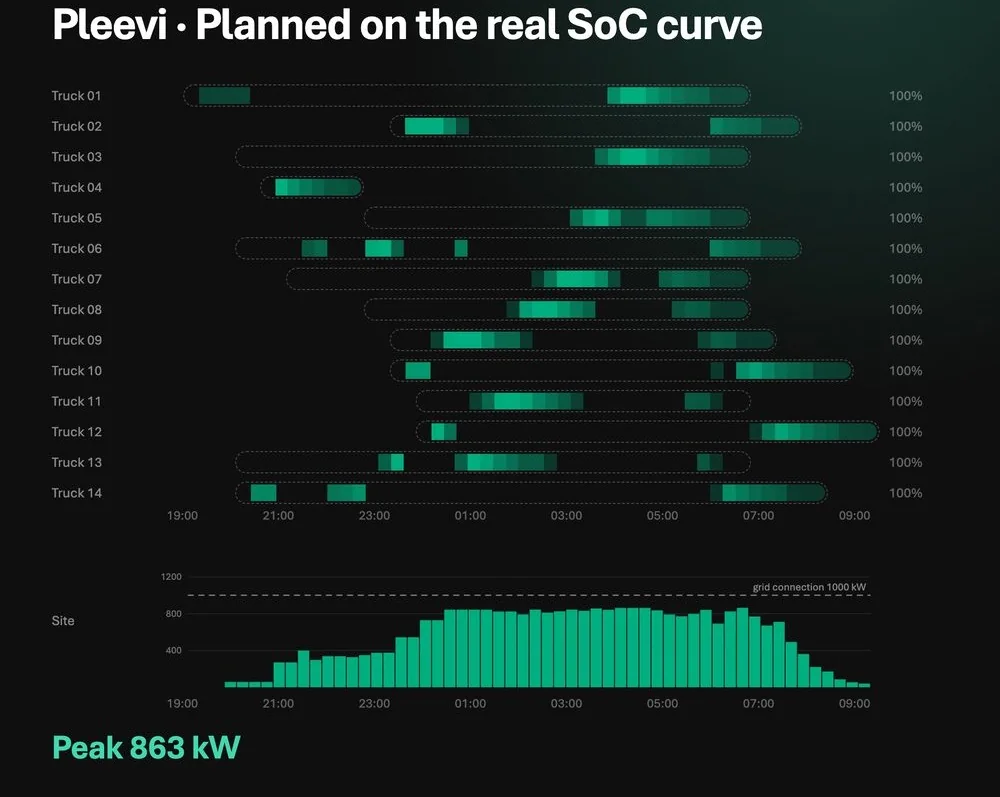
- Pleevi plans on each battery’s real charging curve: every truck full, an 863 kW peak and the lowest total cost.
What each strategy costs a month
Totals over 20 nights, with the energy a truck missed topped up at public fast-charging prices.
| Strategy | A month | Against Pleevi | Trucks |
|---|---|---|---|
| Load balancing | €32,911 | +17% | 1 truck short |
| Flat 100 kW | €29,848 | +6% | 1 truck short |
| Flat 400 kW, no margin | €38,188 | +36% | 10 trucks short |
| Flat 400 kW with a margin | €31,508 | +12% | 1 truck short |
| Pleevi | €28,088 | the baseline | All trucks full |
Pleevi plans every truck on its real charging curve.
The setup
A modelled night at a DC logistics hub: fourteen electric trucks arrive between 7 p.m. and midnight, and most leave again in the morning. The site has a 1 MW grid connection and pays day-ahead prices from EPEX Spot, plus a grid tariff on its peak. For each strategy we ask three questions: is every truck charged in time, what peak does the site draw, and what does the energy cost?
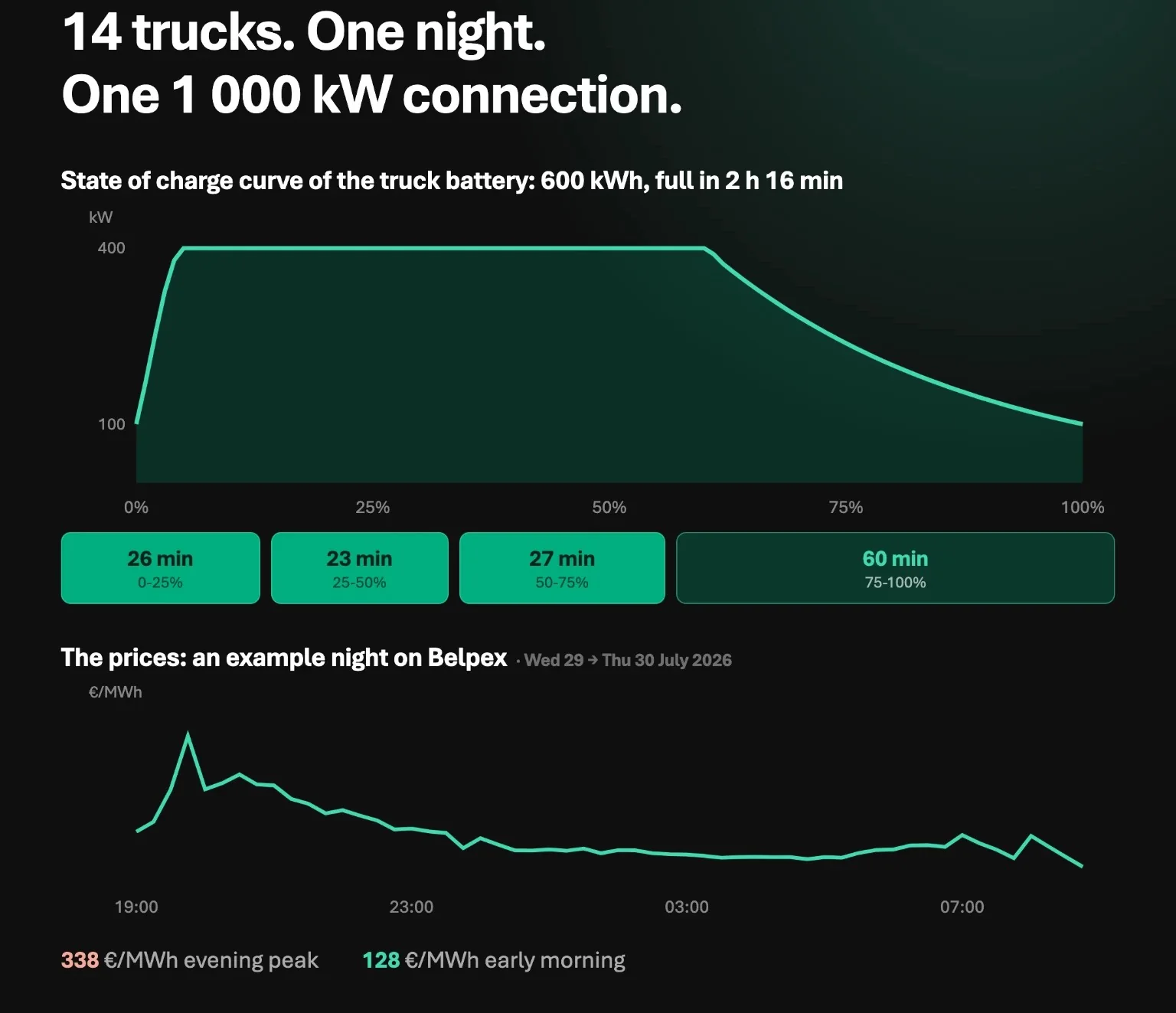
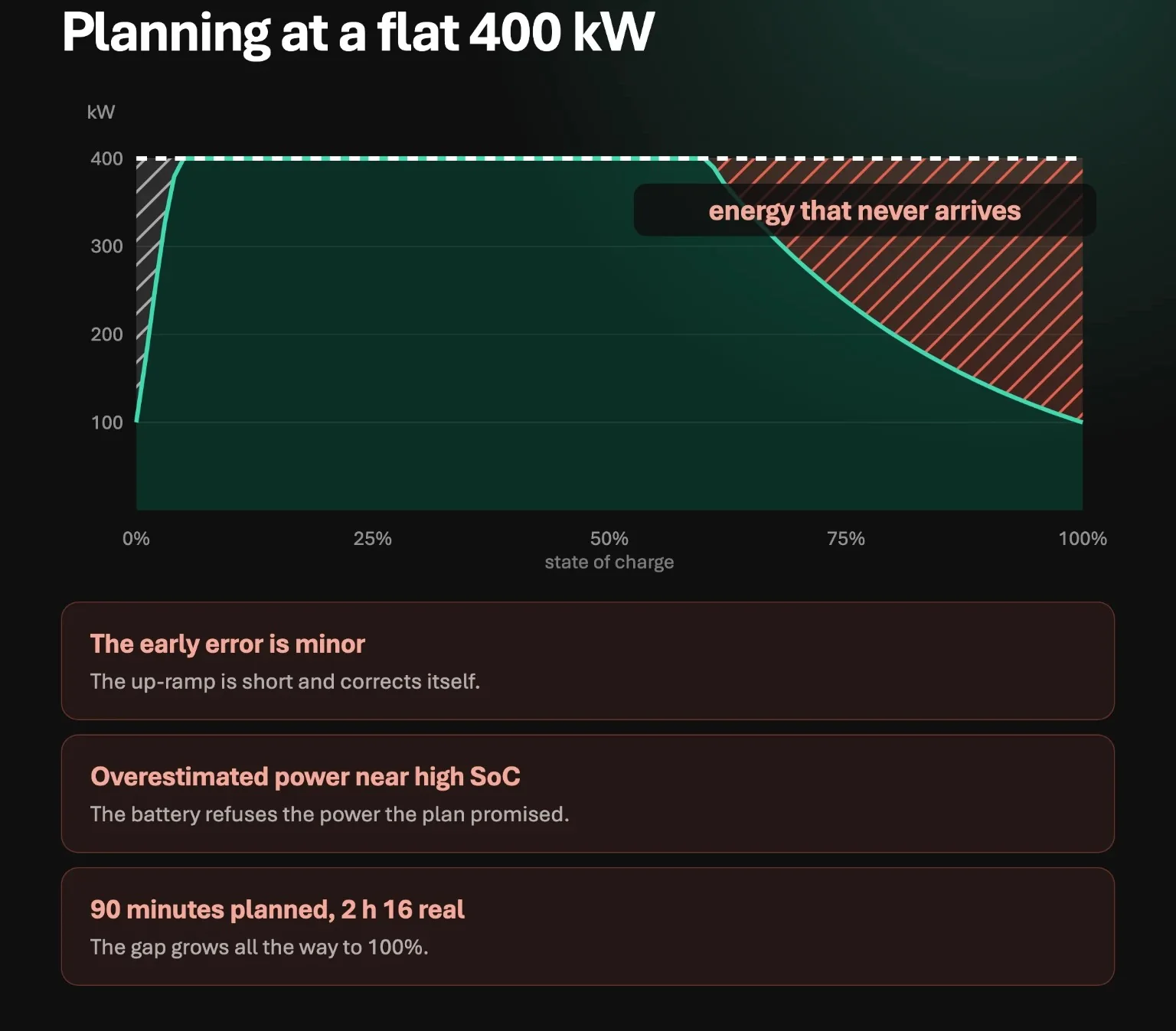
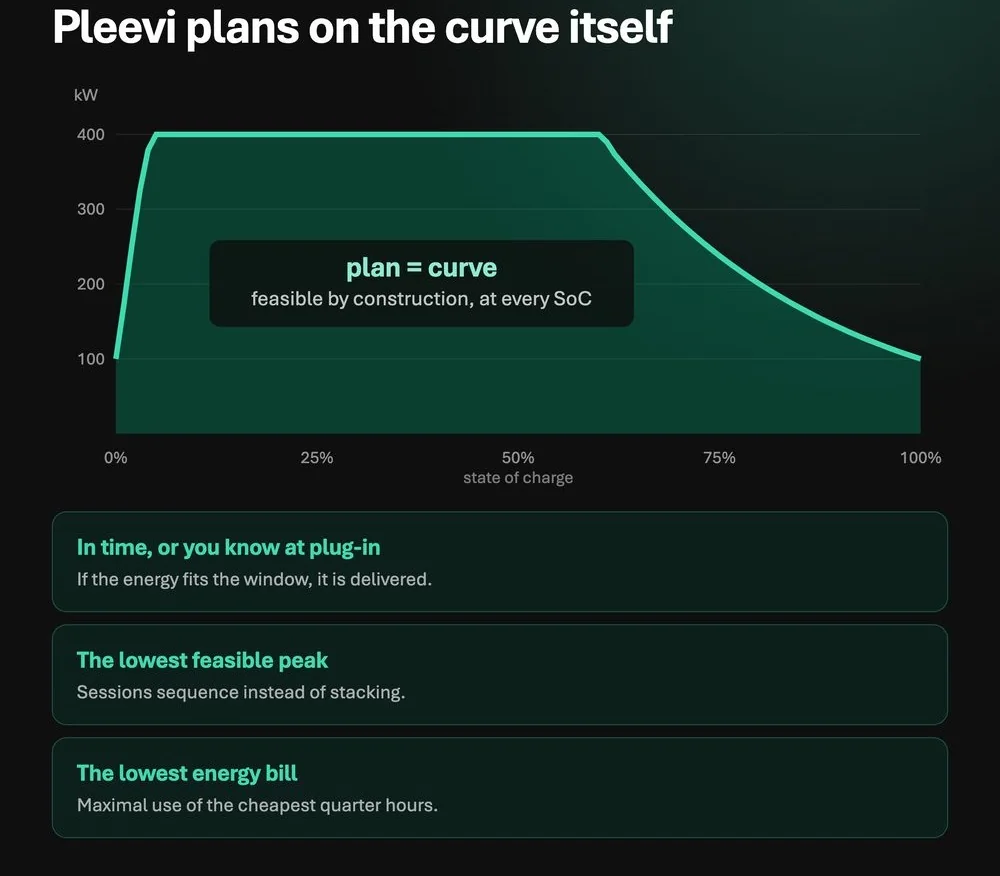
What makes a DC hub hard is the charging curve. A truck charges more and more slowly as its battery fills: the last quarter takes longer than the first half, 2 hours 16 minutes in all at full power. On this night prices start high in the evening and fall through the night, so when a truck charges matters as much as how fast.
1. Load balancing: everyone at once
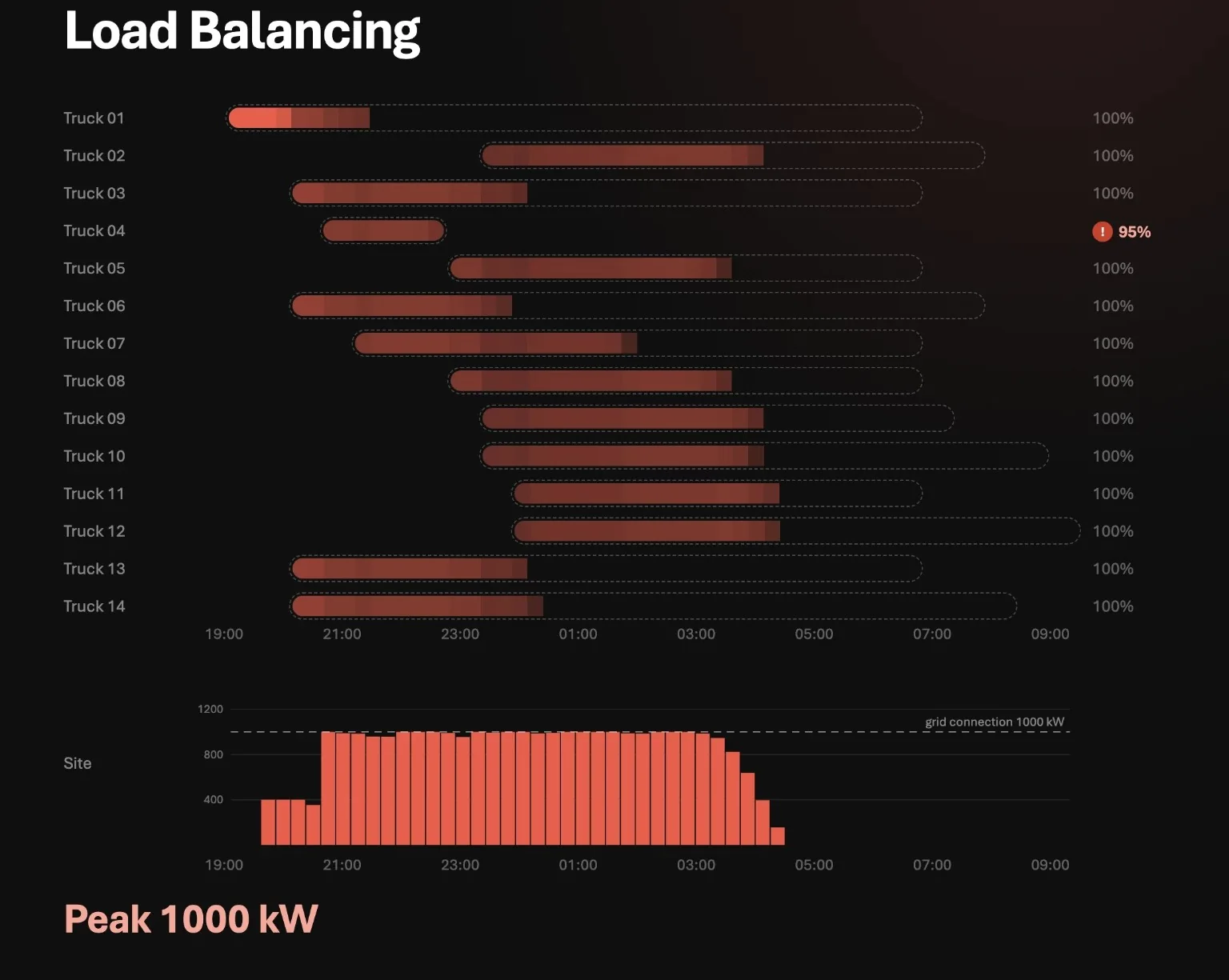
Each truck starts charging as it arrives, and the power is shared among the trucks that are plugged in. The site runs at its full connection until it is done, around 4 a.m., long before the first departure.
That means the highest possible peak, and energy bought in the dearest hours of the night. Worse, it still doesn’t guarantee a full truck: with no priorities, a truck that needs a full charge for its route is throttled like the rest. Here, Truck 4 leaves short, and charging on the road costs far more, in money, in delays and sometimes in penalties.
- Energy
- €28,498
- Grid peak
- €3,905 · 1,000 kW
- Missed energy
- €508
- A month
- €32,911 · 1 truck short
2. A flat 100 kW: easy to plan
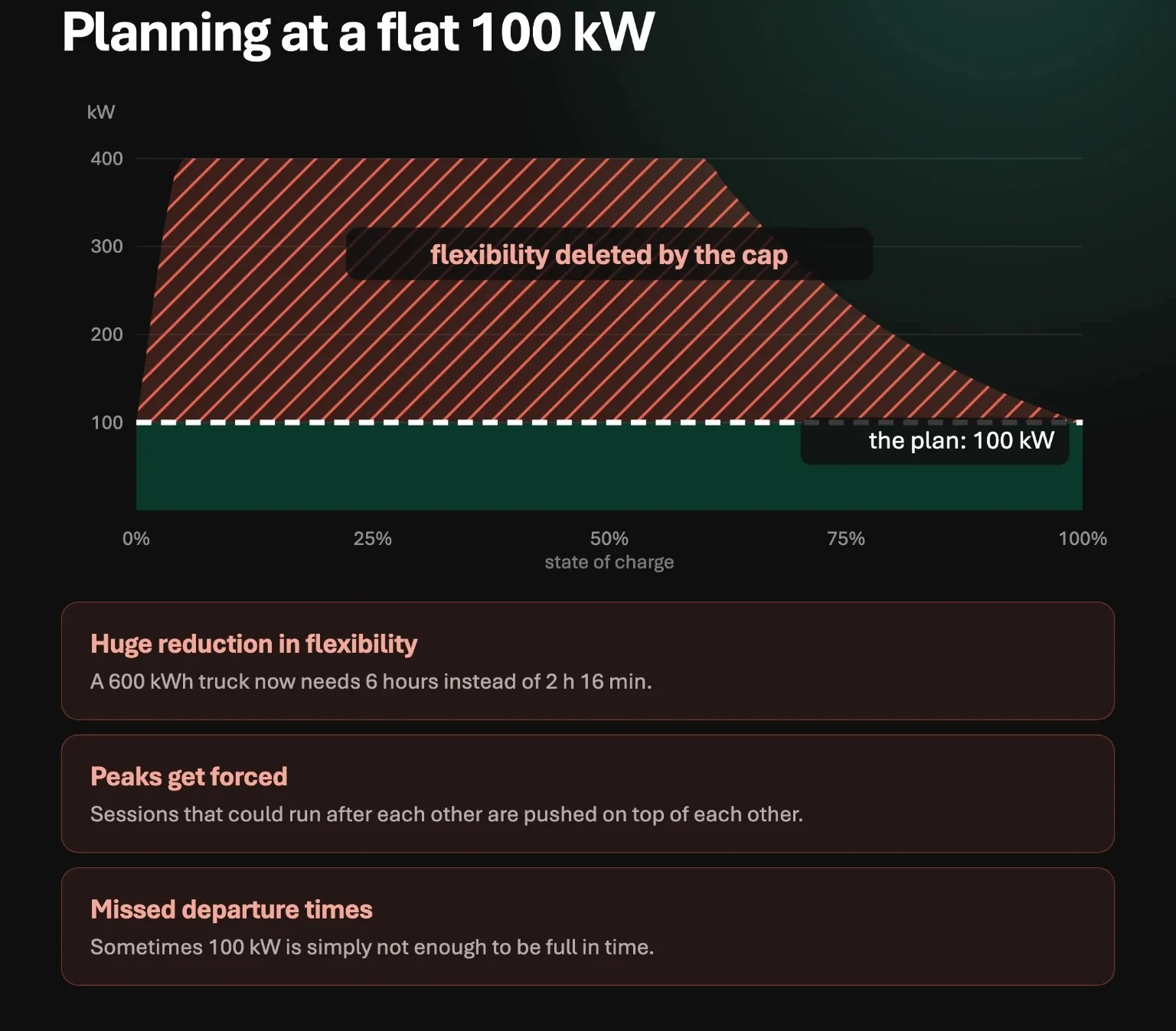
Capping every session at 100 kW sidesteps the curve: DC charging now behaves like AC charging, which is easy to plan. But a truck that would charge in about 2 hours now needs 6, so one that stays 9 hours keeps 3 hours of slack instead of 7.
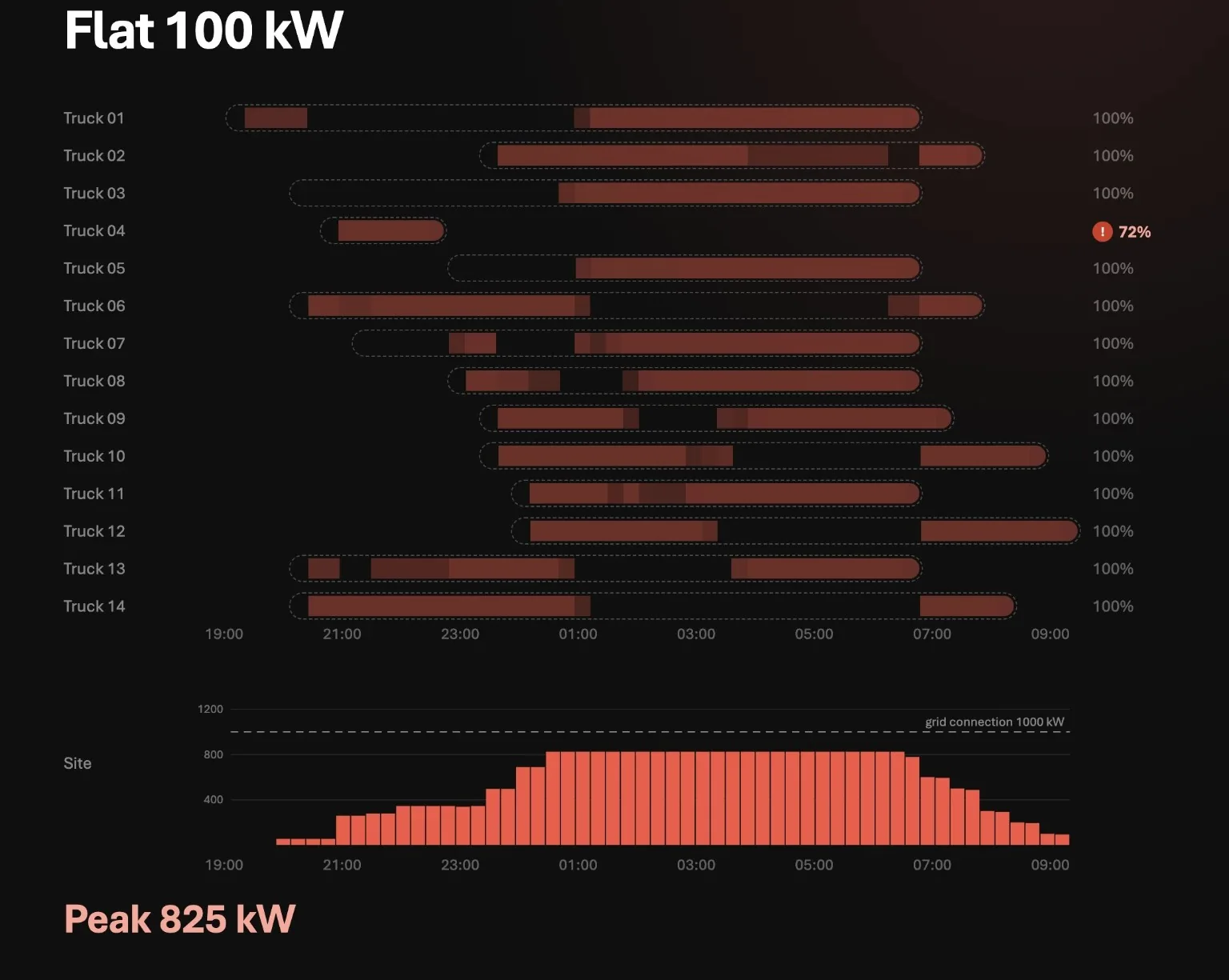
Less room to move means buying more energy when it is dear. The peak looks good on this night, at 825 kW, but the same rigidity can just as well stack sessions into a high peak. And a truck that stays only a couple of hours can’t be filled at 100 kW: top it up at a fast charger on the motorway, and much of the saving is gone.
- Energy
- €24,015
- Grid peak
- €3,221 · 825 kW
- Missed energy
- €2,612
- A month
- €29,848 · 1 truck short
3. A flat 400 kW: ignore the curve
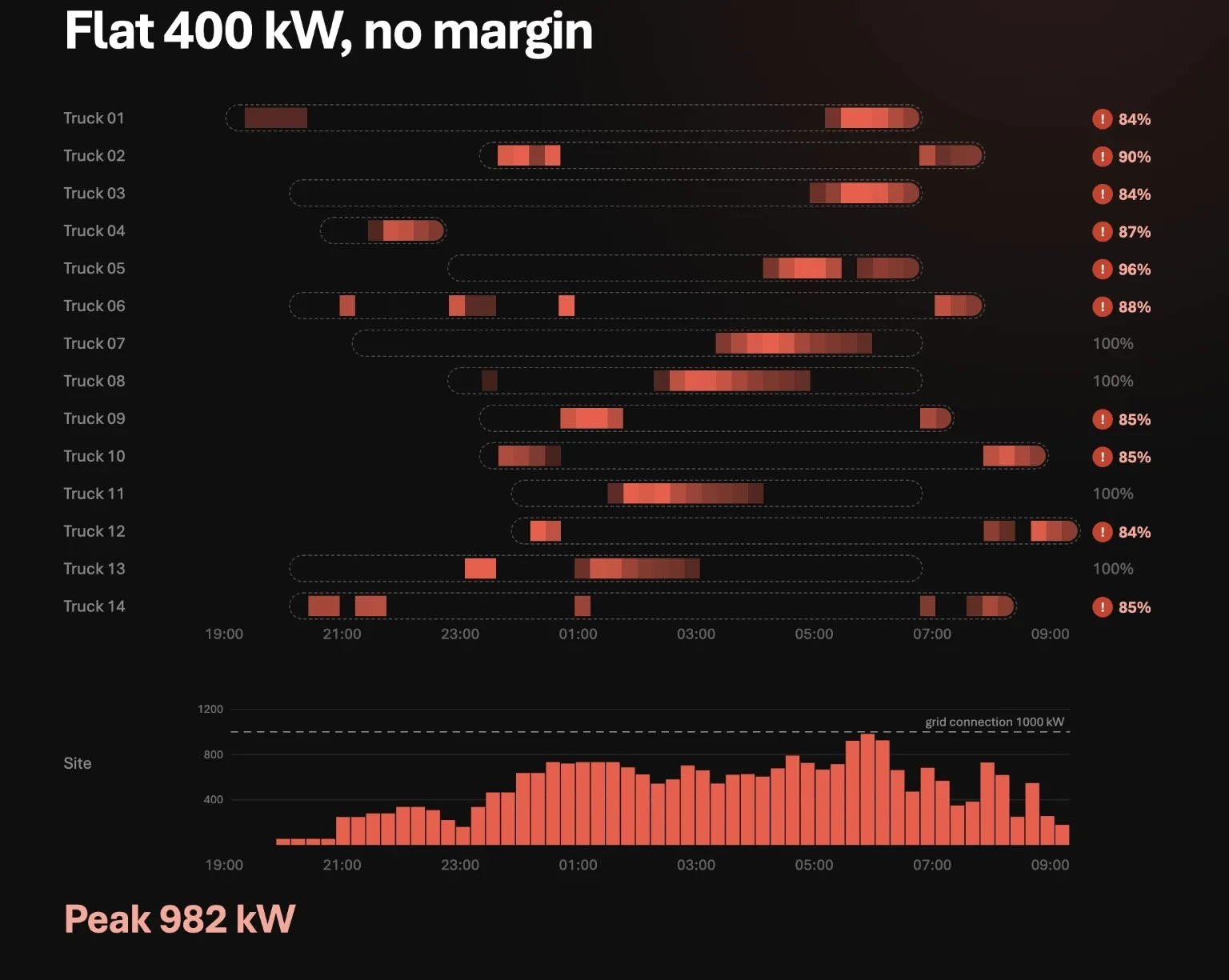
Planning every truck at 400 kW and ignoring the slowdown as the battery fills is the worst strategy of the five. The plan expects a full charge in 90 minutes; in reality it takes 2 hours 16 minutes, half as long again. Many trucks leave short, often with no time left to correct, even when the plan is redone constantly.
The energy looks cheap until the missing kilowatt-hours are bought at public fast-charging prices. The corrections land wherever there is room, not where energy is cheap, and with no flexibility left they stack onto trucks that are already charging, so the peak ends up almost as high as with load balancing.
- Energy
- €21,957
- Grid peak
- €3,835 · 982 kW
- Missed energy
- €12,396
- A month
- €38,188 · 10 trucks short
4. A flat 400 kW with a margin: flexibility is money
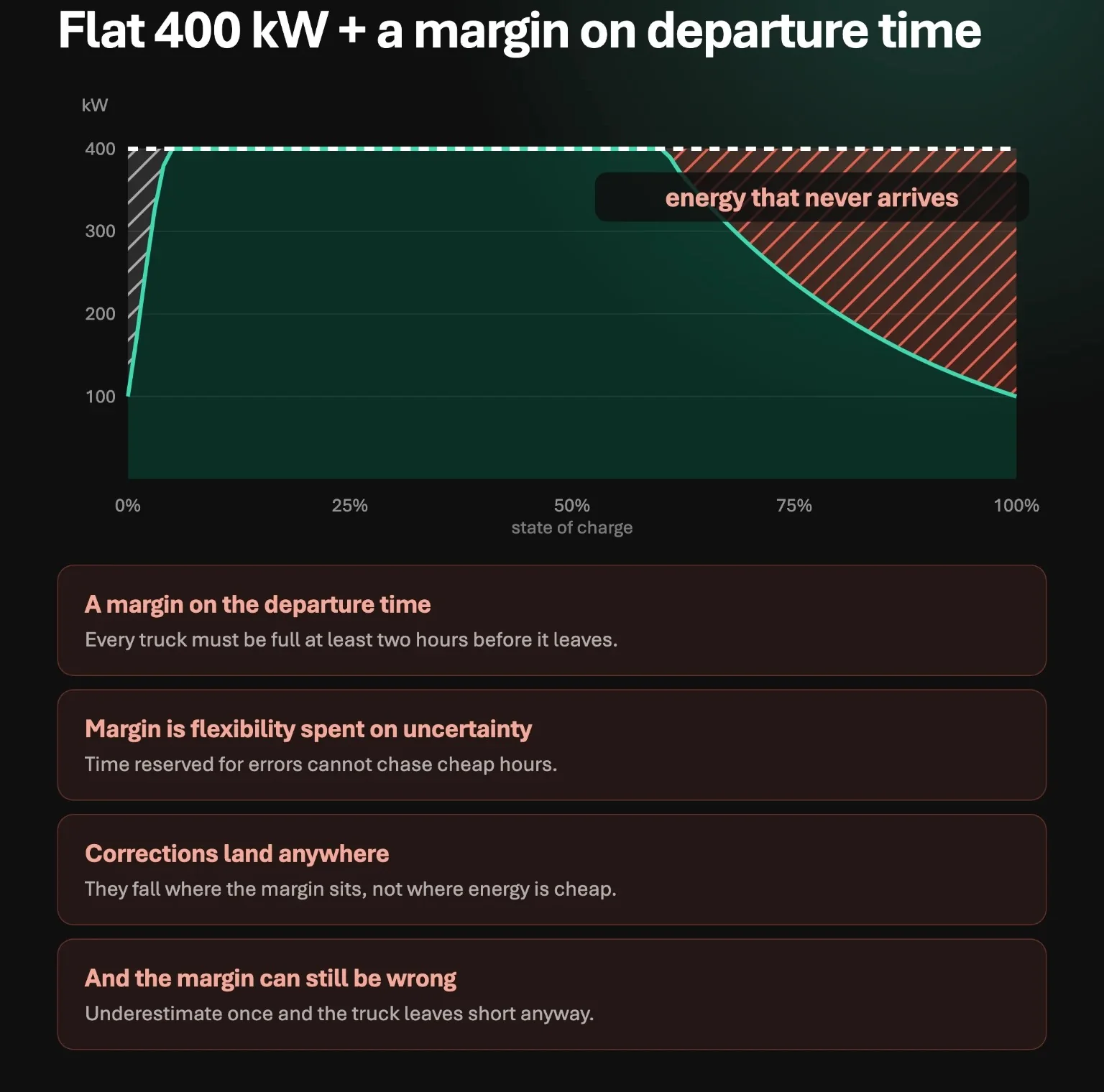
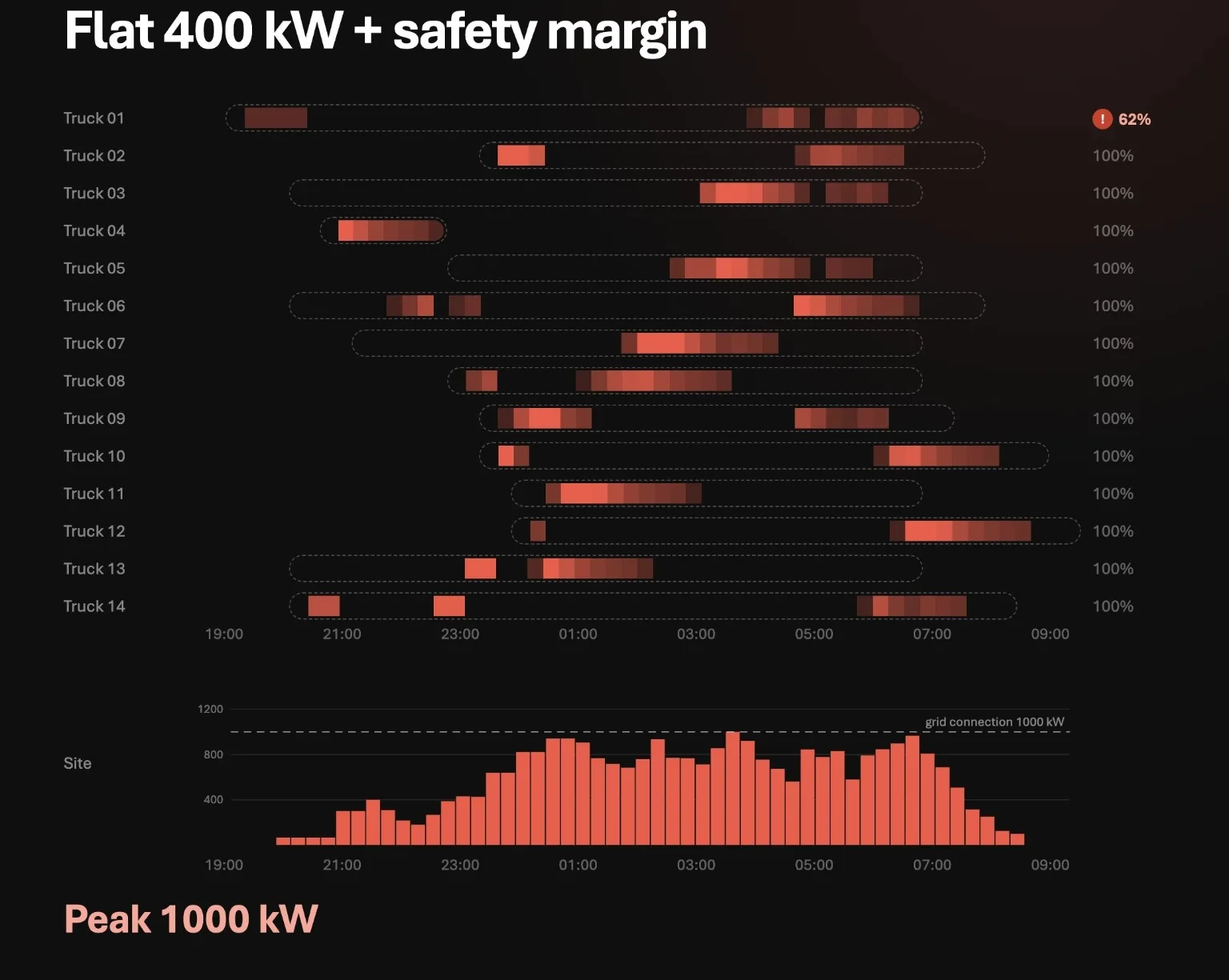
The obvious fix is a margin: plan every truck to be full two hours before it leaves. But the margin is flexibility given up, and flexibility is what lets a site shave peaks and buy in cheap hours. Corrections still land where the margin sits, not where energy is cheap. And the margin can still be too small: Truck 1 needs a correction while the other trucks are already scheduled, and there isn’t enough power left.
Reserving extra power as well as extra time would get every truck full wherever that is physically possible, at the cost of even more flexibility and more money. As it is, one truck still leaves short, the peak sits at the grid maximum, and the energy costs more than it should.
- Energy
- €23,983
- Grid peak
- €3,905 · 1,000 kW
- Missed energy
- €3,620
- A month
- €31,508 · 1 truck short
5. Pleevi: plan on the real curve
Every strategy above left at least one truck short. Load balancing never favours one vehicle over another, and the plans built on a flattened curve went wrong at 100 kW and at 400 kW, with or without a margin.
Pleevi plans every truck on its real charging curve. Knowing what each battery will do, it charges every truck in full, with the lowest peak that is feasible and the lowest energy bill. A flat 100 kW can look cheaper on the supplier’s bill, but only because the bill leaves out the truck that didn’t get its charge.
On this constrained site, Pleevi charges every truck and still costs 6% less than the next-best strategy. On sites with more room, charging every truck isn’t the hard part, but that room is worth money, and Pleevi turns it into savings of up to 30%.
- Energy
- €24,717
- Grid peak
- €3,371 · 863 kW
- Missed energy
- €0
- A month
- €28,088 · all trucks full