

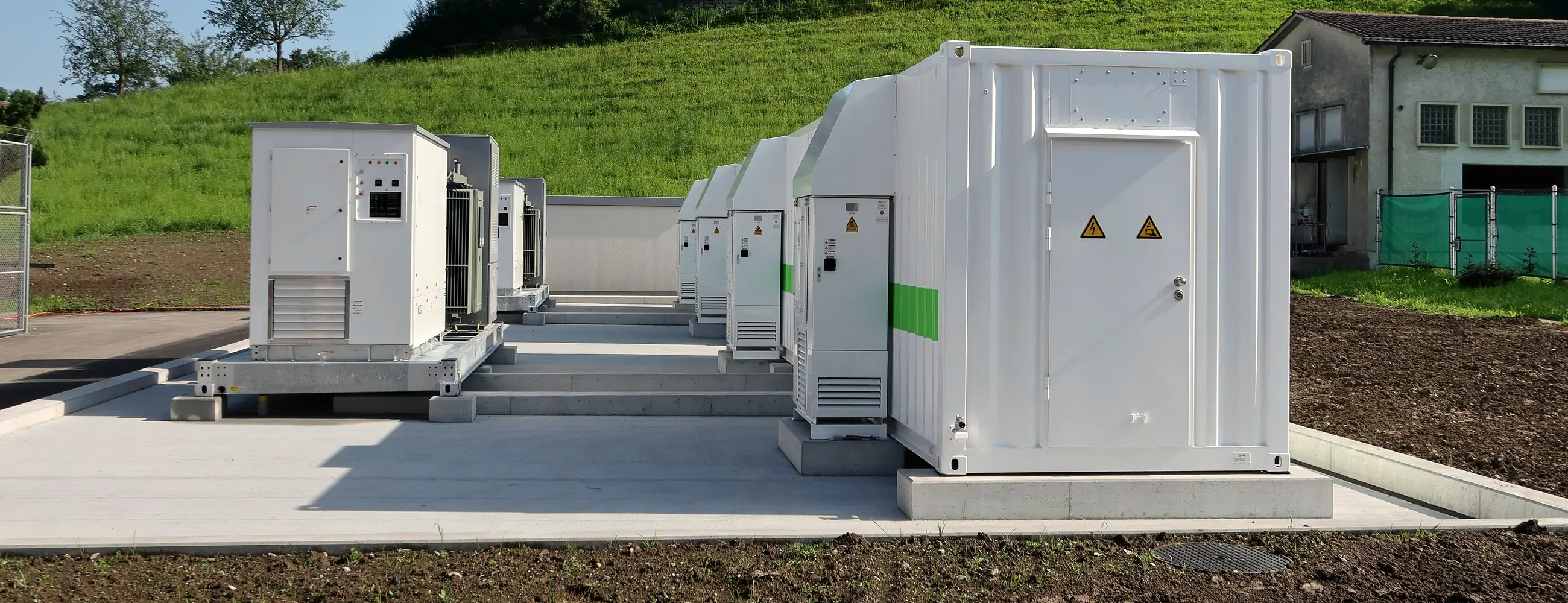
Battery containers in a row beside their cooling units and inverters, at a substation on a green hillside in Switzerland

Your BESS, planned ahead

Pleevi predicts your energy demand and plans the battery around it, with or without chargers. That means fast charging without a grid upgrade, more use of your own solar, and energy bought when it’s cheap.

Battery storageSolarDC fast chargingEnergy markets
The challenge

Three problems, and how Pleevi handles them

Fast chargers ask more of a connection than it can give, and a battery only helps if it is in the right state at the right moment.

More power than the connection has

A fast charger draws 150 to 350 kW, more than most connections supply, and a grid upgrade takes 12 to 24 months.

With PleeviCharges the battery ahead and lets it cover the chargers’ peaks, so grid draw stays under the limit.


A battery with limits

Every charge and discharge has to fit how full the battery is. And every cycle wears the battery down a little.

With PleeviKeeps enough charge for the peaks ahead, and weighs every cycle against what it costs the battery.

Prices that move all day

Day-ahead and spot prices change the value of every kilowatt-hour through the day.

With PleeviCharges the battery in low-price periods and discharges it during expensive peaks.

How it works

Predict the demand, then plan the battery

The battery is ready for what the day will ask of it, not for what just happened.

Predict the demand

Pleevi forecasts charging demand from past patterns, the time of day, the season and special days. That way, the battery is already charged before the spikes it needs to cover.

Buy low, use high

Charged in cheap hours and discharged into expensive peaks, on day-ahead and imbalance prices.

Shave the peaks

Grid draw limited during spikes, with stored energy covering the difference.

Look after the battery

Every cycle weighed against the battery’s cost per cycle (LCOES), within its state-of-charge limits.

Results

What it brings, part by part

Typical results across Pleevi sites with a battery:

What Pleevi doesWhat it brings
Peak shaving40–60% lower demand charges
Price arbitrage15–30% lower energy costs
Solar self-consumptionSolar used on site up from 30% to 80% and more, with a battery
Grid connectionFast charging without a grid upgrade
Charger availability100% charger availability, even during grid peaks

Up and running on the site you have

  1. Tell us about your site

    An intro call about your grid connection, your assets and your energy contract, and what you want to get out of them.

  2. We connect the Edge

    Your electrician or one of our installation partners mounts the plug-and-play Edge in your electrical cabinet. It works with chargers, batteries, inverters and meters from all major brands.

  3. Pleevi runs the site

    Pleevi plans and steers every asset from then on, and Pleevi Studio shows you what the site saves, month by month.

FAQ

Questions we often hear

Does it work without EV chargers?

Yes. Pleevi steers a battery on its own or together with solar and building loads: shaving peaks, storing cheap energy and using more of your own solar.

How does Pleevi decide when to charge and discharge?

It forecasts your load, your solar production and the prices on the day-ahead and imbalance markets, then plans when to charge, discharge or hold, and re-plans whenever something changes.

Can the battery earn money on the markets?

Yes. Pleevi follows day-ahead and imbalance prices and can earn congestion-management revenues, and through certified market partners it adds FCR, aFRR and mFRR, and wholesale and capacity-market bidding.

Does it work with our battery?

Very likely. Pleevi works with the major battery and charger brands, connected on site by the Pleevi Edge.

Is this your site? Let’s talk.

Book a call, and we look at what Pleevi would do on your site.

Wout, our co-founder,
will walk you through it

Book a demo