

Four
parts,
one
EMS
Forecast, optimize, steer
The engine works in three layers. Most energy systems wait for something to happen and then react. Pleevi plans ahead. It makes a plan for every device on your site, like solar panels, batteries and chargers, and it updates that plan all day. That can cut your energy and peak costs by up to 30%.
Predict prices, consumption and production
Pleevi forecasts your site a day ahead: the solar it will produce, the demand of your buildings, when each EV arrives, and the energy prices. The forecasts build on more than ten years of applied research at VITO and EnergyVille.
Solar · demand · EV arrivals · pricesOptimize when anything changes
Using those forecasts, the engine plans all your assets together: batteries, solar, buildings and chargers, all on one grid connection. It combines peak shaving, self-consumption and energy trading in a plan that keeps updating. When a price changes, a cloud passes or a car plugs in, the engine updates the whole plan right away, even for hundreds of assets.
Day-ahead · Imbalance · Smart scheduling · Charging curvesIn three tiers: Base, Upgrade and Monetize ↓Steer every second, on site
A forecast remains a forecast. So Pleevi steers actively: every charger, battery and inverter on site follows the plan every second, and the plan is corrected against what really happens.
Offline operations · Arbitrage steeringPick the optimization plan that fits your site
Live monitoring and load balancing, on fixed rules: no forecast and no plan.
Every asset within your grid limit.
A lower cost for every kilowatt-hour.
Your flexibility earns on the markets.
Monitoring & control
- Live monitoring of every site and asset
- Load and phase balancing within your grid limit, also offline
- Remote control and alerts
- DSO RTU compatible (telecontrol, netflex, fallbackflex)
Forecasting
- Forecasts of solar, site load and energy prices
Optimization
- 24-hour plan per asset, re-optimized every 15 minutes
- Peak, price, solar and battery optimization
- Charging planned around every departure
Drivers & reporting
- Driver App and charging profiles
- Monthly benefit report
Markets
- Imbalance trading and congestion revenues
- Ancillary services (aFRR, mFRR), intraday and wholesale markets*
* Delivered together with third parties.
Up and running fast, with one team to call
The Edge is plug-and-play, and one team supports it together with the software.

In your electrical cabinet
It clicks onto a DIN rail next to your grid connection and joins your site’s network, in minutes. Built on the Revolution Pi Connect industrial controller.
Connected to every asset
Hardware agnostic: it works with chargers, batteries, solar inverters and meters from all major brands, and it is DSO RTU compatible (telecontrol, netflex, fallbackflex).
Steering every second
Pleevi Edge carries out the engine’s plan. Every second, it sends each asset its setpoint and measures your grid connection. If the internet drops, your site still stays under its grid limit. Edge keeps following the last plan, which covers the next 24 hours. Only if no new plan arrives within 24 hours does it switch to local load balancing.
Industrial-certified
UL-certified, CE and UKCA marked, and built to the IEC 61131-2 industrial controller standard. EMC-tested to IEC 61000-6-2/-6-4, so it runs reliably in the harshest electrical cabinets.
Real savings, made visible
Pleevi Studio shows what every site saves, and why: live insights of energy flows, the forecast for the rest of the day, and each month’s savings against load balancing.
Set up a site in two steps
Map the site, its grid connection and its assets, then add your energy contract. Operators, installers and site owners each get the access their role needs.
Follow it live, and ahead
Insights shows every asset’s power as it happens and the forecast for the rest of the day.
See the savings, month by month
Benefit Reporting sets each month against load balancing: the energy and peak costs saved, and the peaks avoided.


Charged on time, at the lowest cost
Drivers keep charging the way they do today. When they want a say, the Driver App gives it to them, and Pleevi plans around it.
Plug in and badge
Drivers plug in and badge as usual, and Pleevi links each session to its driver.
Set a departure and a target
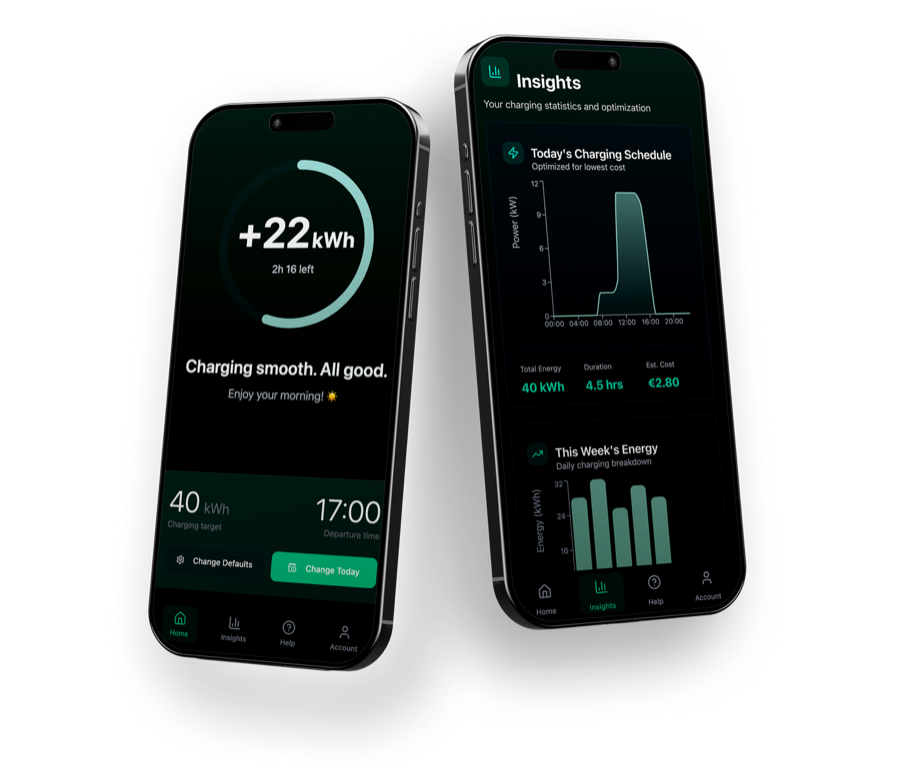
In the app, a departure time and a charging target, changed in a tap. Without them, the defaults set for the car park or the charger apply. The app also shows today’s charging schedule and the week’s energy.
Charged on time
Pleevi plans each charge to be ready by the departure, at the lowest cost and within the site’s grid limit. Drivers see how far along the charge is and when it will be done, and an urgent charge starts with one tap.
Let’s run it on your site
Tell us about your site, and we show you what Pleevi would plan there and what it would save.
